CHENGDU HUARONG HUIDA NEW MATERIAL CO., LTD.
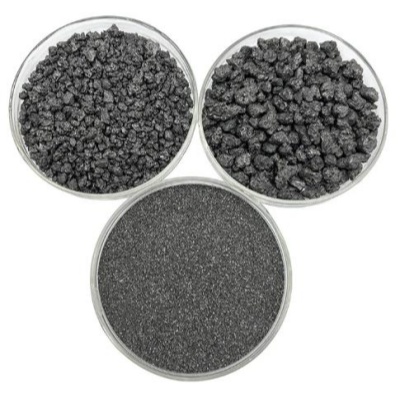
Calcined Petroleum Coke
The primary application of Calcined Petroleum Coke is in the production of anodes for the aluminum smelting process. Approximately 70%-80% of CPC is utilized in the aluminum industry.
Products DETAILS
Calcined Petroleum Coke
Production process:
Raw material preparation: Select high-quality pitch coke as raw material, and undergo crushing, screening and other processes to obtain a particle size range suitable for calcination.
Calcination treatment: The asphalt coke particles are placed in a high-temperature calcining furnace for calcination treatment, usually under a controlled atmosphere to ensure that the particles undergo pyrolysis and crystallization transformation at high temperatures to form calcined asphalt coke.
Cooling and packaging: The calcined pitch coke particles are cooled and then packaged according to customer needs to ensure product quality and safe transportation.
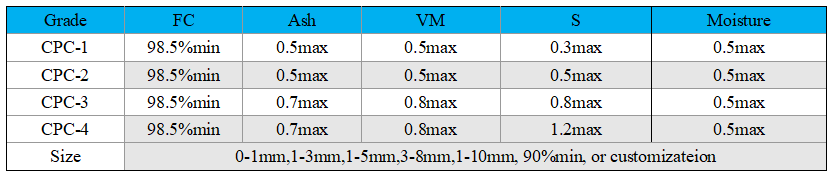
Advantage: Low sulfur content: After calcination treatment, the sulfur content of calcined pitch coke is low, which reduces sulfide emissions produced in industrial production and is beneficial to environmental protection. Uniform particle size: After screening and calcination, the particle size of the calcined asphalt coke is uniform, which is beneficial to transportation and use in industrial equipment.
Applications: Steel smelting: Calcined pitch coke can be used as a high-quality fuel and reducing agent for blast furnace ironmaking and electric arc furnace smelting in the steel smelting process.
Refining industry: Calcined pitch coke can be used as a raw material for refining catalysts and adsorbents, playing an important role in the refining process and helping to improve product quality and yield.